When Moving a Guitar Lead Makes a Fender Amp Hum
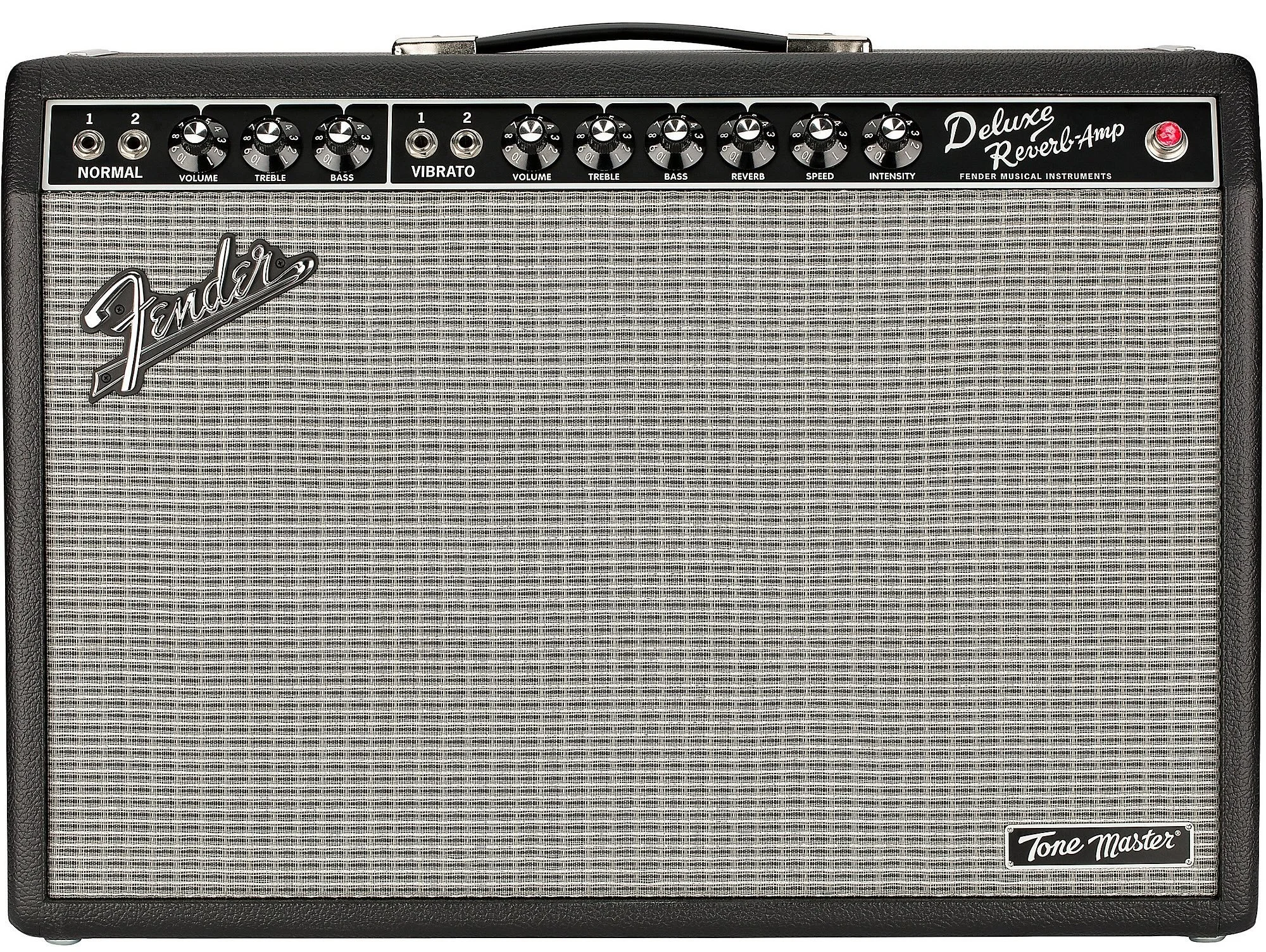
Fender Tone Master Deluxe Reverb
A customer recently brought an almost-new Fender Tone Master Deluxe Reverb to Analog Clinic with a fault that initially sounded like a grounding problem inside the amplifier.
With jack cables inserted into the amplifier, touching or moving a lead sideways at the socket produced an objectionable hum. This was not simply a case of touching the exposed metal body of a plug. The fault could be produced by applying lateral pressure to an inserted cable, regardless of the particular plug-body design.
That detail matters because it points towards the mechanical fit between the plug and socket.
After discussing the problem with Fender, I was authorized to replace all four jack sockets. Fender also raised a concern that some lower-quality instrument cables use plugs that do not conform closely enough to the dimensions expected by the sockets.
The repair therefore raises two related questions:
Could an incorrectly dimensioned plug be causing the apparent amplifier fault?
Why were the replacement Fender sockets different from those originally fitted?
Not every “quarter-inch” plug is exactly the same
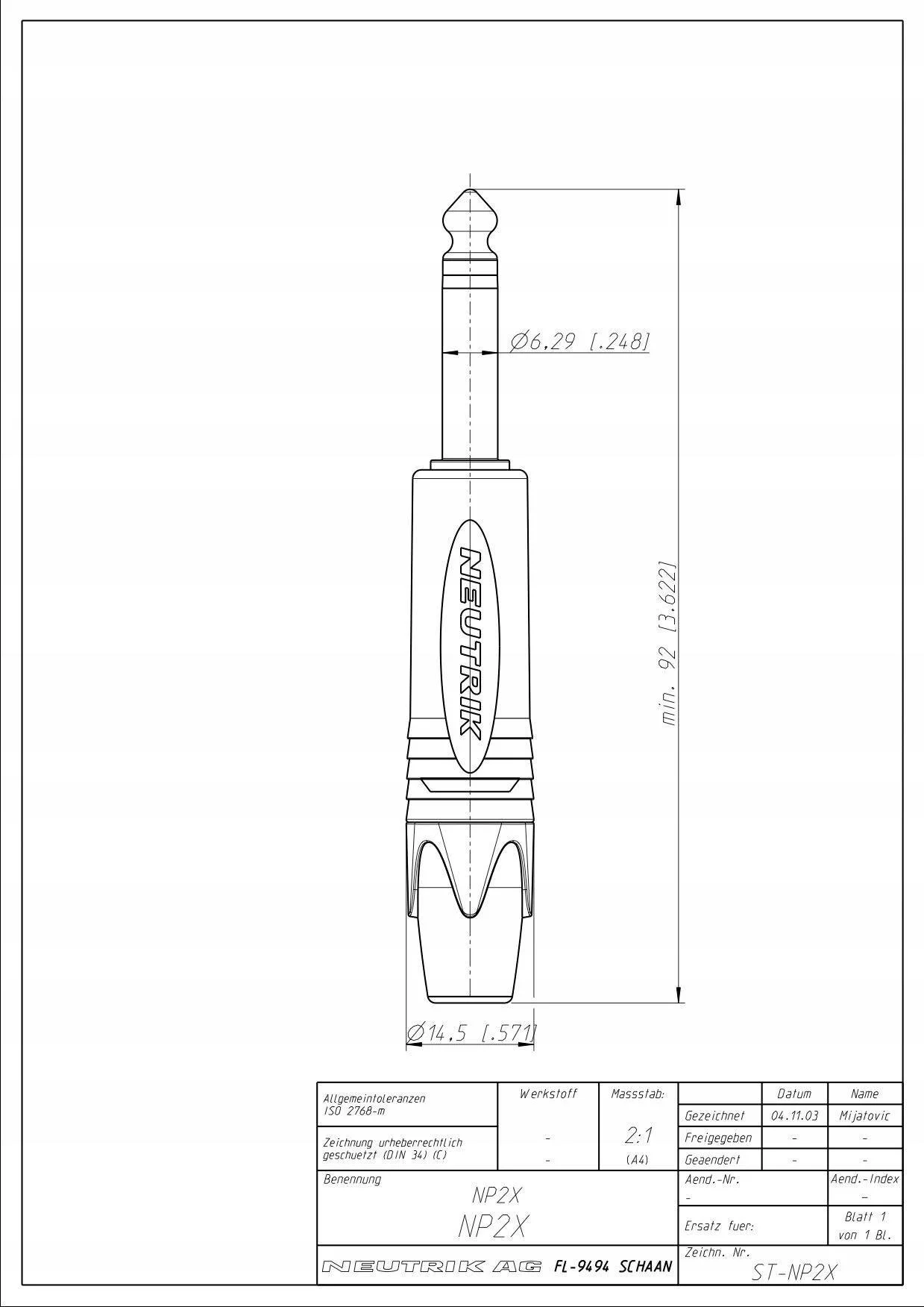
Neutrik Diagram of a jack plug.
We commonly refer to these connectors as quarter-inch jack plugs, but that description can create a false impression of universal precision.
A professional plug is nominally 6.35 mm, or 0.250 inch, but plugs from different manufacturers can vary slightly in diameter, tip shape, contact position, surface finish and overall geometry.
For example, a current Neutrik technical drawing shown above specifies a shaft diameter of approximately 6.29 mm, while a nominal quarter inch is 6.35 mm. That difference may appear insignificant, but a few hundredths of a millimeter can affect how firmly a plug is held when combined with socket tolerances and the pressure of its spring contacts coupled with general wear and tear.
Switchcraft manufactures a long-established range of quarter-inch plugs and sockets specifically for guitar and professional audio applications. Its products are often treated within the industry as a reference point for compatible dimensions and mechanical fit. That’s who Fender us as a reference.
Strictly speaking, it is therefore better to talk about plugs meeting the expected quarter-inch geometry and manufacturing tolerances than to describe every variation as a failure to meet a formal “Switchcraft standard.” Switchcraft is a manufacturer, not the sole international standards authority, but its components have become an important practical benchmark in the musical-instrument industry.
How cheaper plugs “cheat” the dimensions
Some inexpensive plugs save material or simplify manufacture by making the shaft fractionally smaller, altering the profile of the tip or allowing broader production tolerances.
The plug will still enter the socket and pass a signal, so it appears compatible. However, it may not push firmly enough against the socket’s sleeve and tip contacts.
That can result in:
Excessive sideways movement
An intermittent ground or screen connection
Crackling when the cable is moved
Momentary signal loss
Hum that appears when lateral force is applied
Mechanical stress on the socket and its PCB solder joints
This is not merely theoretical. Musicians and technicians regularly report that some plugs fit tightly in a known-good socket while others rattle or move noticeably in the same socket. One discussion specifically describes some plugs as tight in a Switchcraft socket while others were loose enough to rattle. Another notes that a plug worn or manufactured to a smaller diameter can become a significantly looser fit.
There are also reports of compatibility differences between traditional full-size American plugs and some imported metric components. Those reports should not be taken as proof that every imported connector is inferior—Neutrik, for example, makes excellent professional connectors—but they do illustrate that apparently interchangeable plugs and sockets do not always share identical dimensions.
Why sideways cable movement can create hum
A guitar lead normally carries:
The audio signal on the tip
The signal ground and cable screen on the sleeve
The socket contains spring contacts that press against these areas of the plug.
If the plug is slightly undersized, or the socket does not grip it sufficiently, moving the cable laterally can reduce the contact pressure. The sleeve connection is especially important because it joins the cable screen to the amplifier’s ground.
A marginal sleeve connection may continue to pass audio while no longer providing a reliable low-resistance screen connection. The cable and the person handling it can then couple supply/mains-frequency interference into the sensitive amplifier input.
That explains why the fault can sound like an internal amplifier grounding problem even though it is being triggered mechanically at the plug-and-socket interface.
A poor fit can also lever the internal contact away from the plug. With a PCB-mounted socket, the movement may additionally flex the socket terminals and solder joints.
The cable may be the problem—but not always
Fender was right to raise the possibility of poor-quality leads. Trying a known-good cable should always be an early diagnostic step when an amplifier hums, crackles or cuts out as the cable is moved.
Advice given by technicians for decades has been to eliminate the simple external causes first: try a different cable, try another instrument and examine the input socket before assuming there is a major fault inside the amplifier.
However, changing the cable is not the end of the diagnosis.
In this case:
The amplifier was sensitive to lateral movement of inserted leads.
Fender authorized replacement of all four sockets.
The replacement sockets were physically different from the originals.
The replacement sockets gripped the plugs more firmly.
Replacing them resolved the fault.
The evidence therefore suggests that the original sockets were at least part of the problem, even though an undersized or poorly made plug could make the symptoms considerably worse.
Fender’s replacement sockets are different
The photograph below shows the components removed from and supplied for this Tone Master Deluxe Reverb.
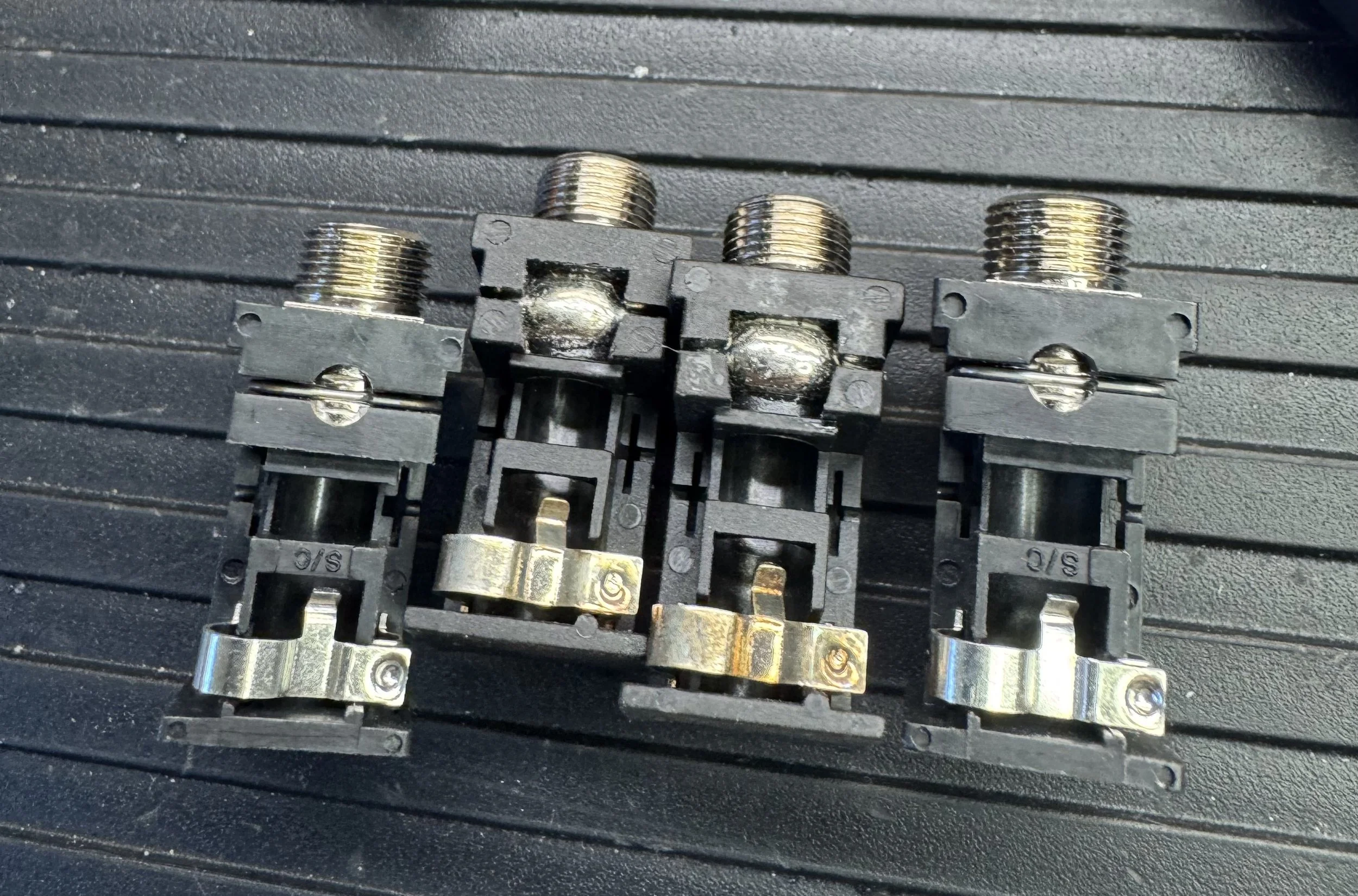
The two sockets in the center are the original parts. The two outer sockets are the replacements.
The replacement sockets use a visibly different mechanical construction. They also felt noticeably snugger and more positive when plugs were inserted.
It is possible that the revised design applies greater spring pressure to the plug or makes a more dependable sleeve connection. It may also support the plug more effectively against lateral movement.
However, without Fender’s internal engineering or supplier information, it would be inappropriate to claim that the sockets were redesigned specifically to correct a known grounding defect.
The change could represent:
An engineering revision
A different approved supplier
Improved contact pressure
Better mechanical support
A production change unrelated to this particular symptom
What can be stated with confidence is that the replacements were different, they held the plugs more securely and the amplifier no longer exhibited the fault after they were installed.
Original and replacement Fender sockets
The revised sockets also demonstrate why simply inspecting a socket from outside the amplifier may reveal very little. A jack can look normal and pass a basic test while losing reliable contact when the cable is pushed sideways as much as it can be caused by a cheaper quality lead.
Choosing a suitable instrument lead
This repair is a good reason not to choose a guitar cable solely by appearance or price.
The audible difference between two properly designed instrument cables may be debated endlessly, but the mechanical quality of their plugs is not imaginary. A connector must be manufactured accurately, grip correctly and maintain dependable electrical contact while the cable is moving.
A good diagnostic or everyday lead should use plugs from a reputable manufacturer such as:
Switchcraft
Neutrik
Amphenol
G&H Industries
Other established professional connector manufacturers
A Fender-branded cable is also a sensible choice when testing a Fender amplifier because it removes much of the argument about whether the connected lead is appropriate for the equipment, especially under warranty claims.
The point is not that a Fender logo makes a cable electrically superior. The point is to use a cable whose plugs are manufactured to controlled dimensions rather than an anonymous plug that merely looks approximately the right size.
A simple test guitarists can perform
With the amplifier at a safe, moderately low volume:
Insert a known-good professional cable fully into the socket.
Make sure the other end is plugged into an input source to avoid loud induced hum.
Note how positively the plug engages.
Gently move the cable sideways close to the amplifier.
Listen for hum, crackle or signal interruption.
Repeat the test using another known-good cable with a different reputable plug.
Now try your bargain cable/s.
Compare the amount of mechanical play between them and note any unwanted sounds.
There will normally be some movement because a jack is not a rigid locking connector. However, modest lateral movement should not produce hum, crackling or loss of signal, and be pretty snug.
Do not repeatedly wrench the cable from side to side. This risks damaging the socket or breaking PCB solder joints. The test should use only enough movement to determine whether the electrical connection is stable with expected movement of the cable, the type you get if you’re an energetic musician.
Do not confuse a loose plug with a loose socket
There are two different faults that are often described as a “loose jack.”
The first is when the entire socket assembly is loose in the amplifier panel because its fixing nut has worked free. These nuts are always coming loose. Old 1960s design.
The second is when the socket itself is firmly mounted but the inserted plug fits loosely inside it.
Fender provides guidance on tightening a loose instrument socket where the fixing nut and complete jack assembly are moving. That is a different problem from the one described here, where lateral movement of the plug within the socket affected the electrical connection.
Tightening the panel nut will not correct an undersized plug or weak internal socket contacts, but it will ensure a good ground.
This is not a traditional Deluxe Reverb internally
The Tone Master Deluxe Reverb is intended to reproduce the sound and playing experience of the classic Fender Deluxe Reverb, but its internal construction is fundamentally different.
It is a modern solid-state and digitally modelled amplifier. Fender’s ability to issue firmware that changes aspects of the amplifier’s response—including reverb behavior and the simulated bright-cap response—demonstrates how different its architecture is from that of the original analog tube amplifier. Hint: tubes are better. I am biased (pun intended).
The particular amplifier discussed here was manufactured in approximately 2024–2025. Internally, it uses printed circuit-board assemblies and PCB-mounted controls and connectors of the type commonly found in modern mass-produced electronics.
That does not mean it is a bad amplifier. The Tone Master offers low weight, reduced heat, useful output-power settings, direct recording facilities and a credible reproduction of a familiar Fender sound, and it is loud!
It does mean however, that it is not constructed like a vintage Fender or an older point-to-point or eyelet-board tube amplifier.
On an older Fender, a jack socket is often a substantial open-frame component mounted through the chassis and connected by wire. On a modern PCB-based amplifier, the socket may also serve as a physical support while being soldered directly to a circuit board.
Consequently, sideways loading of a plugged-in cable can be transmitted to:
The socket body
Its internal contacts
The soldered terminals
The PCB pads
The copper tracks
The surrounding circuit-board assembly
That makes the dimensional fit of the plug even more important.
What this repair teaches us
The lesson is not simply that cheap cables are bad, nor is it that every Tone Master has defective sockets.
It’s a reminder that a quarter-inch connection is a mechanical system as well as an electrical one.
A plug that is fractionally undersized may work perfectly in one socket but fit loosely in another. A socket with modest spring pressure may work with a full-dimension Switchcraft-type plug but become unstable with a plug manufactured towards the smaller end of the tolerance range.
When both conditions occur together, sideways movement of the lead can interrupt the sleeve contact and introduce hum.
The correct diagnostic approach is therefore to examine the complete interface:
Cable → plug → socket contacts → socket terminals → solder joints → amplifier ground and also check whatever you are connecting to the amp.
Before assuming that the amplifier has developed a major electronic problem, test it with a high-quality, correctly dimensioned lead.
At the same time, do not dismiss the amplifier merely because one cable fits more loosely than another. In this Tone Master Deluxe Reverb, Fender authorized replacement of the sockets, the replacement parts were of a different design, they gripped the plugs more securely, and replacing them corrected the fault.
I also tested with Fender genuine leads as well as Neutrik and Switchcraft. They were super snug.
You spend 1000s of dollars on your gear. Buy some $25 cables :-)
Sometimes the cable exposes the weakness. Sometimes the socket does. Often, it is the interaction between the two.